




How Driving Styles Damage Profits
Note: This article summarises the key thinking behind our research project. The full evidence-based PDF report — with data, numbers and references — is available on request below.
Most fleet managers attribute rising running costs to fuel prices, insurance rates and expected vehicle wear & tear. But one factor quietly overshadows all of these — driver behaviour.
Two drivers in identical vans, driving the same route, can produce dramatically different cost outcomes based purely on how they operate the vehicle.
Industry research shows the true cost of aggressive driving
Industry research shows that aggressive driving — defined as rapid acceleration, harsh braking and reactive “point-and-shoot” decision making — can increase fuel consumption by up to 40% in urban driving conditions.
Behavioural driving patterns are also linked to:
- significantly higher accident risk and so increased claims likelihood
- 20–30% greater brake and tyre wear
- increased vehicle downtime through more frequent workshop intervention
- higher insurance premiums over time
These are not just assumptions — they’re measured, ‘research proven’ outcomes.
The striking thing is that these unnecessary running costs aren’t inevitable — they’re just invisible until you measure them. Once you can see them, they become actionable.
That’s why many businesses are launching their own, easy and low cost TrackSave project — that shines a light on driving behaviour, reduces avoidable fuel burn, and brings annual running costs back under control.
Our research-led approach
As an experienced driver myself, living near a main road roundabout and with many years experience working with vehicle telematics, I have become increasingly aware of an apparent increase in UK driver aggression.
Following up this observation, I completed an investigation across automotive studies, transport analytics, fleet telematics datasets, insurance modelling and behavioural driving psychology papers. The output of which is a comprehensive evidence-based report summarising the actual financial and safety impact of driving style — complete with full list of sources and references.
Thanks to a background in Psychology, I approached this project with a determination to uncover the objective and measurable links between behaviour, risk and cost. Wanting clarity — not opinion. Insight — not speculation.
I am 100% confident that driving style is one of the most powerful, yet overlooked cost drivers in business fleets — because the evidence is overwhelming.
The Driving-Style Cost Divide
Two drivers in identical vans, doing exactly the same miles on exactly the same route, can generate very different cost outcomes solely because of how they drive. Telematics data consistently shows that smoother, anticipatory drivers consume less fuel, create less mechanical stress on the vehicle, and trigger fewer braking-related risk events — while reactive, impulsive driving increases fuel burn, tyre wear, and insurance exposure.
Across a 10-van fleet, that difference alone can easily translate into £5,000–£12,000+ extra cost per year, without any external price increase in fuel or insurance or dishonesty regarding private miles travelled. – Money straight off your bottom line.
Idling – The quiet ‘profit-leak’
Many vans idle for 1–2 hours per day, particularly during lunch stops, site delays or while waiting for instructions. That’s fuel literally doing nothing — and over a year, the accumulated cost can be staggering.
Nothing will change – Unless something changes
– Let human nature solve the problem, with an automated driving style league table
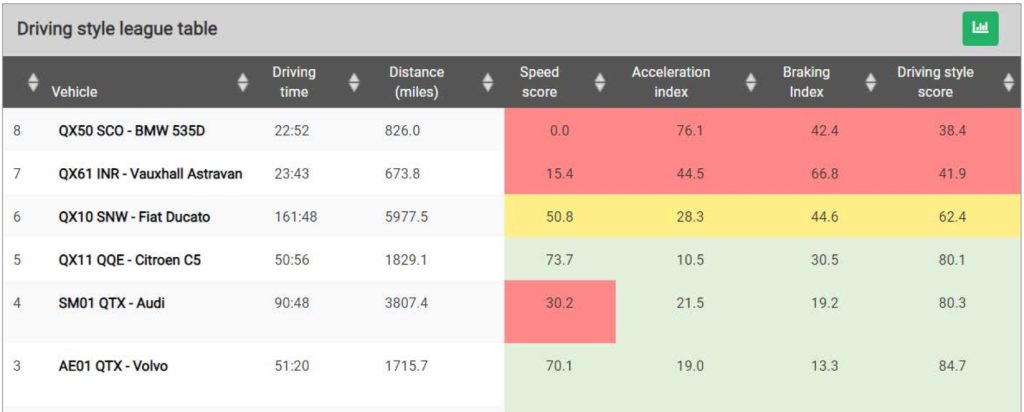
The real value of vehicle telematics isn’t just vehicle location tracking — it’s behavioural insight:
- Which drivers brake late?
- Which drivers surge the throttle?
- Who idles excessively?
- Who drives smoothly and predictively?
Today, easy to use telemetry, linked to a smart phone app can allow even the smallest of fleets to:
- coach drivers
- reduce collisions and claims
- negotiate insurance
- extend tyre and brake life
- manage routing efficiency
- build a safer fleet culture
And over time:
unlock measurable, sustainable cost savings.
The economics of this are frankly hard to argue with. There’s no setup cost, the first 3 months are completely free, and even after that it’s under £10 per vehicle per month.
When aggressive driving alone can push real-world fuel usage up by as much as 40%, this becomes less of a “nice-to-have technology solution” and more of a basic financial correction.
In the face of the potential annual savings, it’s one of the clearest operational “no-brainer” decisions a manager can make.
Access our full research findings
We’ve consolidated the most reliable and current research into a clear, easy-to-read report — complete with reference sources used — so businesses can understand the real mechanics of behavioural cost.
Download the full research report (email required)
See your drivers’ real behaviour
Knowing that behaviour matters is one thing. Seeing which of your drivers cost you money is something else entirely.
If you’re curious what poor driving behaviour might actually be costing you, we’ve built a calculator that shows you the financial impact using your own fleet profile. No signup, no email gate — just clarity in under a minute.
👉 Check your fleet’s cost impact with TrackSave
If the number surprises you, that’s good — because it’s the starting point of your TrackSave project to reduce it.
TrackSave works with Quartix vehicle telematics to help businesses uncover behavioural cost inefficiencies in their own fleets — and many see real ROI from the first month of implementing the insights.
Find out how a TrackSave project powers behavioural savings
The irony is that businesses don’t adopt TrackSave because they’re excited about telematics. They adopt it because letting avoidable costs continue is just bad business.
If you choose to work with TrackSave, you contract directly with the telematics provider and there is no cost uplift — TrackSave is sponsored by them.