




Why reclaiming VAT on vehicles isn’t as simple as “car vs van” anymore — and what SMEs must watch for. As with all our articles DO NOT treat this as advice and ensure that your qualified Accountant has validated any decision you take after reading this information.
If there’s one area of vehicle taxation that consistently catches business owners out, it’s VAT.
Superficially, the rules sound simple:
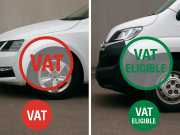
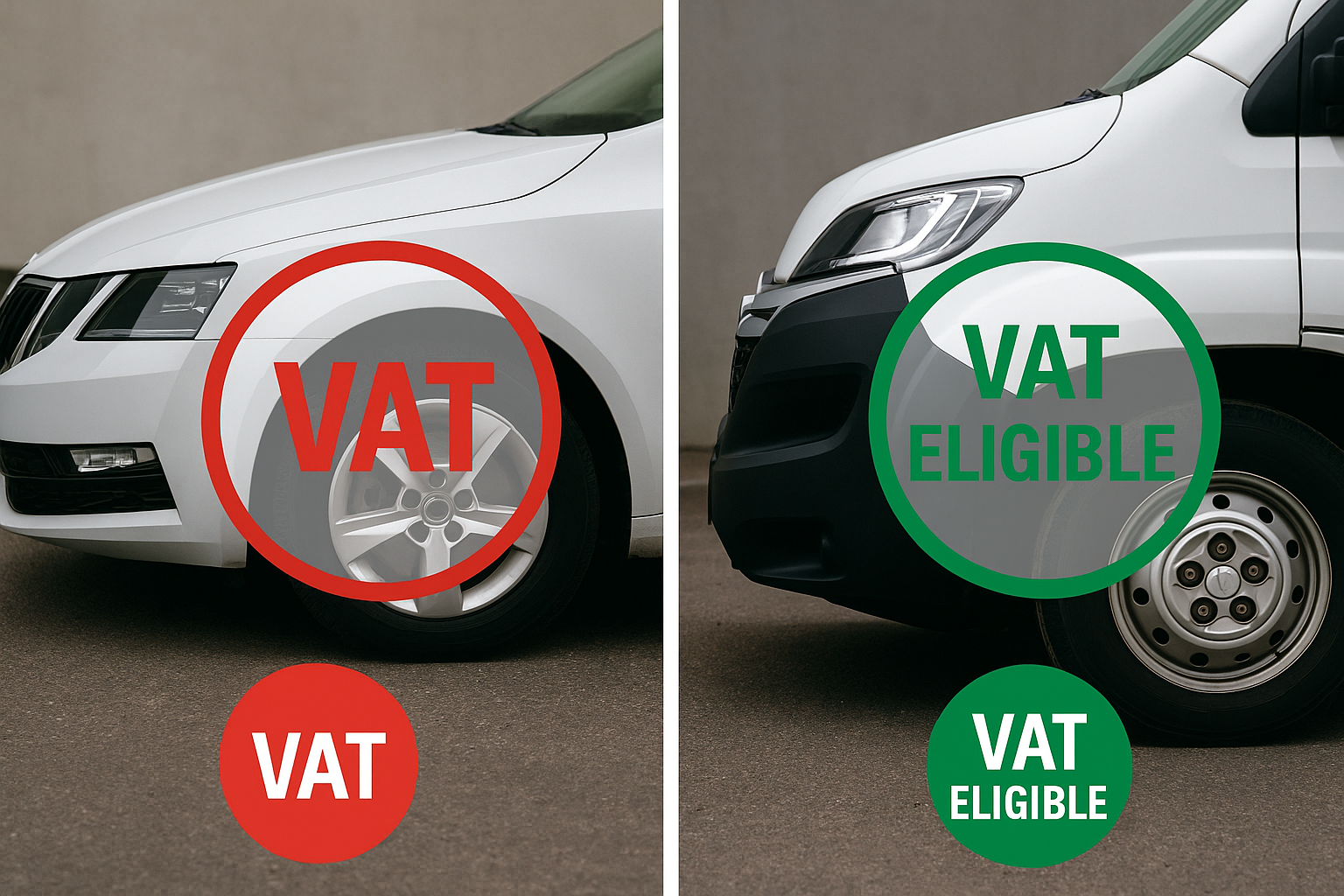
- Cars → no VAT reclaim
- Vans → full VAT reclaim
But in 2025/26, the reality is far more complex — especially after HMRC’s tightened definition of what counts as a van, new treatments for double-cab pickups, and the very different VAT rules for leasing vs buying.
VAT on Cars: Usually You Can’t Reclaim
HMRC’s position on cars is blunt:
If a vehicle is classed as a car, you generally cannot reclaim input VAT, even if you use it heavily for business.
The only exceptions are:
- Driving school cars with dual controls
- Car-hire & leasing firms buying cars for hire
- Taxis, private hire and chauffeur services
- Cars used exclusively for business with no private use whatsoever
That last bullet point is theoretically possible — but in reality, HMRC treat any possibility of private use as disqualifying. The bar is set very high.
Translation:
If it has seats, is practical for personal use, and isn’t dedicated to a special trade → VAT is almost always non-recoverable.
VAT on Vans and Commercial Vehicles: Much Friendlier
For commercial vehicles, the rules switch:
- 100% VAT reclaim is allowed on the purchase price or lease payments
- No private-use restriction as long as the business has a legitimate commercial use which forms the bulk of what the vehicle is actually used for
- Applies to vans, panel vans, LCVs, pickups meeting the commercial definition, and trucks
For most SMEs, this is the key VAT advantage:
Buying or leasing a van gives you a 20% instant saving compared with a car.
However, you must pay the VAT upfront, even on a used vehicle, and most Hire Purchase plans will not allow the VAT element to be financed.
The Double-Cab Pickup ‘Shake-Up’
For years, double-cab pickups (Hilux, Ranger, Amarok etc.) were treated as vans for VAT purposes.
HMRC changed the rules in 2024, tightening the criteria around payload and construction. As of 2025:
- Some pickups still qualify as commercial vehicles (full VAT reclaim).
- Others — particularly lifestyle or high-spec models — may now be classed as cars instead.
This matters because a misclassified pickup could mean losing thousands in VAT and triggering a correction during a VAT inspection.
Simple rule:
Check the manufacturer’s payload.
If it carries 1 tonne or more, it usually qualifies as a van.
Below that it is likely to be regarded as a car.
- This may have something to do with why so many ‘family pickups’ at the school gates are now so incredibly huge!
VAT on Leasing vs Buying: The Key Differences
If you BUY a vehicle outright
- Cars → VAT not reclaimable
- Vans/commercials → VAT fully reclaimable
If you LEASE a vehicle
Cars (on lease):
- You can reclaim 50% of the VAT on the finance rentals
- You can reclaim 100% on maintenance/service package VAT payments.
However For the 100% reclaim on maintenance to be possible, the maintenance charge must be shown as a separate line item on the leasing invoice. If it forms part of a single lease payment without a separate breakdown, the entire amount typically falls under the 50% rule.
It may therefore be wise to negotiate separate (non maintenance) lease and maintenance package. However, take great care that the lease does not include a “balloon lease payment” at the end of the agreement. Or if it does, be absolutely certain that the value of the vehicle at the end of the lease will be sufficient to pay the balloon and that this is the responsibility of the lease company, not you.
Vans/commercials (on lease):
- VAT → 100% reclaimable
- Maintenance/service VAT also 100% reclaimable
For many directors, this makes leasing a van far more cash-efficient than buying a car privately.
Mixed Use, Private Mileage and Common Pitfalls
HMRC know that many “business vehicles” double as weekend family transport.
So they pay attention to:
- Fuel VAT reclaims
- Whether the business charges employees for private use
- Whether a vehicle genuinely fits commercial needs
- Whether the business operates a mileage-recording system
Fuel VAT
You have two choices:
- Reclaim VAT only on business fuel (requires robust mileage logs), or
- Use a fuel scale charge, a fixed amount added to output VAT to offset private use.
Poor mileage records are apparently one of HMRC’s favourite adjustments during inspections.
Real-World Scenarios for SMEs
Scenario A: The Director’s EV Company Car
- VAT on the purchase not reclaimable
- VAT on a lease only 50% reclaimable
May still be the best tax choice because of ultra-low BIK – BUT not a VAT-saving opportunity
Scenario B: A Tradesperson’s Panel Van
- Full 100% VAT reclaim on purchase or lease
- Full reclaim on running costs
Usually the most VAT-efficient form of business transport
Scenario C: The “Luxury” Pickup
- If payload < 1 tonne → classed as a car
- No VAT reclaim on purchase
- Only 50% reclaim on lease
Many owners discover this too late
Scenario D: A Fleet of Staff Cars Under a Salary-Sacrifice Scheme
A business can effectively pass on the benefit of the VAT reclaims to staff through a salary sacrifice scheme, structured such that the employee is charged for the use of the car at a rate that is net of the 50% VAT reclaim on the lease payment and net of the 100% VAT reclaim on the maintenance element.
- However the BIK element in Salary sacrifice affects income tax and NI
- Does not make car VAT reclaimable
VAT Summary for 2025/26
| Vehicle Type | VAT Position | Notes |
|---|---|---|
| Cars (any fuel) | ❌ No VAT reclaim | Unless exclusive business use (rare) |
| Cars on Lease | ⚠️ 50% reclaim | Maintenance VAT is 100% reclaimable |
| Vans & LCVs | ✅ 100% reclaim | The simplest VAT win |
| Pickups | ⚠️ Depends on payload | Over 1 tonne = usually reclaimable |
| Electric Cars | ❌ No VAT reclaim | Low BIK helps elsewhere, not VAT |
| Electric Vans | ✅ 100% reclaim | Best VAT + tax combination |
Bottom Line
VAT on vehicles isn’t intuitive — and HMRC’s 2024/25 clarifications have made the line between cars and vans sharper than ever.
- If it’s a car, assume no VAT recovery.
- If it’s a van/commercial, assume full VAT recovery.
- If it’s a pickup, check the payload before you sign.
Leasing doesn’t change the underlying classification — it just changes how much VAT you can reclaim on the rental payment.
Although, thanks to the leasing company’s ability to reclaim 100% of the VAT on car purchase prices, monthly lease rentals are calculated on the vehicle cost Net of VAT – so do, in effect, pass 50% VAT saving ‘down the line’.
Get those distinctions right, and you avoid unexpected VAT bills while ensuring your business claims what it’s legitimately entitled to.

Update for: VAT on Cars, Vans and Pickups in 2025
2025 Budget – Key VAT-Related Changes for Vehicle Owners
The Budget didn’t overhaul VAT rules on vehicles, but it introduced several changes relevant to business owners and fleet operators.
The headline shift is the confirmation of a new road-pricing system from 2028, where electric vehicles will pay 3p per mile and PHEVs 1.5p per mile. While not a VAT measure, it affects total cost of ownership calculations — especially for fleets currently relying on fuel-duty savings.
Importantly, the Government did not change the VAT rules distinguishing cars from vans, nor the tightened 2024/25 criteria for double-cab pickup classification. This means the existing VAT framework still applies:
-
Cars → VAT usually not reclaimable
-
Vans/LCVs → VAT fully reclaimable
-
Pickups → VAT eligibility determined by payload
There was also no reversal of the decision to delay changes to Employee Car Ownership Schemes (ECOS) until 2030, which keeps current VAT and tax treatments stable for now.
These Budget updates reinforce the need for businesses to stay aware of future cost trends while relying on the existing VAT regime in the short term.